Showing posts with label prairie gardening. Show all posts

Tuesday, May 1, 2012

Fruitscaping- Vertical Space: Walls or Trellises


So you want to plant some climbing fruit on your wall or trellis? Perhaps you have a pergola that could use some coverage? As you begin experimenting, consider planting the following fruits in combination with hops or virginia creeper (for fast, dense coverage) or scarlet runner beans or clematis (to add some colour).

-Kiwi- Grown in Canada for many years, the fruits are smaller than commercial varieties and the skin is smooth. Fresh, it’s eaten more like a grape: skin and all. While technically a Zone 4, there are many warm ‘pockets’ where kiwis will thrive. Find a south- facing wall, make sure it’s protected (by fence or hedge) from prevailing winds and provide the vine with a strong trellis. Sunstar Nurseries carries, and recommends, the Issai variety as it is self-pollinating. 
<b>ISSAI</b> Hardy Kiwi
Issai Kiwi


As a small aside: I have killed my Kiwi. But I would like to think this is because I didn't follow the instructions to plant it on the south side of my house. I ended up moving the poor thing three times in three seasons and eventually it just gave me the heave-ho-gonna-die-on-you-lo. Will be planting another one this season, in the proper Zone 4 space.

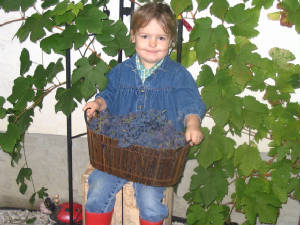
 -Grapes (table and wine)- Often associated with warm, desert-like environments, there are numerous cultivars of grapes for fresh eating and wine making that can be grown in northern gardens. According to Dyrland, “Where you place grapes is crucial. They need sun and shelter from the wind.” Fall pruning and heavy mulching is also necessary to maintain the health of the plant. Your efforts will be well rewarded when fruit appears after its third season. Recommended varieties include: Valiant, Beta and Cliché.
emmawithgrapes.jpg
Harvest off one four-year old vine at Shallow Creek Nurseries.

Another small aside: I had four varieties of grapes... now I have three because I, again, did not follow instructions and experimented with leaving the vine unpruned over the winter. Now in their third season on the south side of the house, I am expecting a bountiful harvest this year from the remaining vines. Watch for my report. 

- Red or Black Currant- “People shy away from currants because they seem like an old-fashioned fruit, but there are great fresh eating and preserving varieties,” says staff at Sunstar Nurseries. Currants, if left alone, will grow into a 3 x 3 foot bush however they can be trained into a fruiting column or globe form. For a beautiful screen, espalier them against a wall or trellis. This is a showy and versatile fruit.  Dyrland recommends any variety that starts with “Ben” like the Ben Conan, Ben Nevis, and Ben Sarek. Check our The Fruit Nut's Blog for extensive information on currants and instructions to espalier one.

Next Fruitscaping post: Trees. 

This reprint is part of an article I wrote for Gardening for the Prairies, Winter 2012. Over the next few days, in time for planting season, I'll publish the list of fruit options you might consider when making landscaping decisions. Planting prairie fruit doesn't have to be limited to the veggie patch or a brambling patch of raspberries in the alley. In this series, we'll look at fruit you can use for ground cover, vertical cover, screens, feature plantings... When it comes to fruit-scaping, thanks to the U of S's many new fruit varieties, us northern gardeners are limited by our imagination, not our Northern climate!


Wednesday, March 21, 2012

Planting Schedule for Edmonton Veggie Gardens

The snow is almost gone off our lawn and back gardens... could it be true that spring has obeyed its placement on the calendar and arrived on time in Edmonton? Of course not, but I will continue to harbour hope that more rain than snow is in the weather god's forecast for the next two months.

This year I created a public calendar with a planting schedule for spring and summer in Edmonton- and I'm excited to share it! You'll find it below as well as in the pages tab on this blog. It includes dates for planting seeds indoors and outdoors, dates for transplanting and planting for continuous crops. I've designated Sundays as my planting day but, if you want to use this public calendar too, feel free to consider the Sunday plantings as plantings for the week- to be done at your earliest convenience. If you plan to follow the schedule for 2nd, 3rd and 4th plantings- make sure you leave space in the garden (or plan for the early harvest of lettuce, spinach, and radishes that will make room for later plantings of carrots and beets!). You'll find that in some cases, there are additional details in the location and description of the event on the calendar.

I've added only those veggies I plan to plant- if you want me to add other crops, please comment below and I'll be sure to add it.


Happy planning and planting!

Tuesday, May 24, 2011

A Green House Tour on 165 Ave

As a greenhouse nut living in Edmonton, I've discovered a route that beats all others: 165 Ave, east of 97 Street. Drive past Alberta Hospital and suddenly its greenhouse/nursery/market garden land. Every quarter kilometre another greenhouse pops up. Little ones, bigs ones. Some of them sell bedding plants, other's just bare root trees and shrubs (found $20 Explorer Series Rose bushes at Arrowhead Nurseries!), others, like Kuhlmann's have huge inventories of garden gnomes and water features. 
One of two hanging baskets.

It's a route on which a great deal of money can be spent on a leisurely Sunday afternoon.

Nearly at the end of the road, past the North West of Edmonton and into the North East, is my favourite spot: Visser's Greenhouse. You may know them as the potato farmers who partnered with Greater Edmonton Alliance to for the "Great Potato Giveaway". They are potato farmers, but also greenhouse operators. And what a greenhouse! Hanging baskets provide a overhead carpet of colour and scents. Each plant stand has a variety of choices, offering ideas for companion plantings in pots and boxes. There's a small coy pond and two areas (one outside with sand, the other inside with slides) for kids to play. Every single plant looks happy and healthy-- can't say that for the meagre offers I saw last weekend at Canadian Tire and Rona. 

This year, I planned to splurge on two of my hanging baskets by our dining table and on the window box Mat just built for the garage. We can see all three of these from the deck where we perch most of summer. 

In year's past I've filled these baskets/box with plants I grew from seed. So my petunias flowered in August, and my squash didn't bother to grow past a foot. Every summer I've been cheap and by August rather disappointed I hadn't cheaped out elsewhere. 

So, buoyed by this hot May long weekend and the magic that is Visser's, my cheap back was broken and I spent an average of $40 per basket/box. I filled them with a sun loving variety of begonia with startling colour then filled them out with purple and green sweet potato vine. I filled the box out with bacopia (sp?) and ivy. 

I am delighted with the result. Now, I HAD BETTER WATER!


When I married Mat, I've got to admit that "handy" wasn't on my list of qualities for a life partner.  Now, 12 years wiser, I realize that that was a critical oversight. Thankfully, Mat's handy AND knows how to operate power tools. Even better, he can turn a boring flower box into a bit of art. 
 

Sunday, May 15, 2011

My Honeyberry Blooms

Berryblue 

Hurray- this week my honeyberries bloomed!  Two summers ago I planted six honeyberries. Since you need at least two varieties to cross pollinate, I was extra careful and bought three varieties. Last summer, I harvested a record of seven berries off one bush. This summer, my goal is to harvest... well, more. There are many more blooms on all the bushes this time around. 

I've experimented a little with the placement of each. Reading that they grow in both part shade and sun, I've planted the six in a variety of sunny to shady spots. There hasn't been much variation in the amount of growth on each bush, perhaps I'll see the difference in the fruit output.

The fruit, if you've never seen it, is a blue, elongated berry shape. The plants come from Siberia and their blossoms withstand -8 to -10 C frosts. The woman I bought my plants from had bushes which bloomed straight through a snow storm and went on to produce a rich harvest. 

The flavour of my seven berries was pretty mild; each was seedless and plump. According to the researchers at the U of S Fruit Program, however, flavour can range from "terrible to terrific" so there is still ongoing experimentation in the flavour department. 

Shannon Dyrland, who's Shallow Creek Nurseries closed last year, recommends the varieties Cinderella, Berryblue and Bluebell. Many of the greenhouses now carry at least a couple varieties of honeyberry.

Keep in mind too, if you plan to landscape with these, that they aren't fussy about soil Ph, which can't be said for their cousins the blueberry and huckleberry (both need acidic soil). 

So, if you have a honeyberry bush, please let me know where you've planted it and if the fruit output has changed significantly when planted in the sun versus the shade! 

I'll keep you posted on my ambitious goal of "Eat More Than Eight Honeyberries in 2011".

Tuesday, May 10, 2011

A Stick in the Mail

I got a stick in the mail today- shipped from Winnipeg in a long, six-foot box lined with brown paper.

T & T Seeds tells me that this stick is a Hazelnut- a Flibert Hazelnut (hybrid of American wild hazelnuts with their better fruiting cousins in Europe)- and I can only trust them that this is true.

At the base of this stick is a bulbous growth wrapped in twine mesh. Inside the mesh is a root ball hugged by cedar shavings to help with the shock of the trip in the back of a Canada Post truck. Obedient as I am, I followed the directions and now have the root ball soaking in a mop bucket, accompanied by a High Bush Cranberry that at least is leafing out and looks somewhat like the bush it will be.

In the bazooka sized cardboard box, I also pulled out two, four-inch lingonberry plants, a Ben Nevis Currant, some onion sets and seed potatoes. In baggies were five other plants: three are a I've-fogotten-the-name-of-perennial which I purchased with no research (the flowers nearly burst out of the catalogue!). Two of the baggies are clematis plants, one purple and one red, but you'd never know it. Seriously, all that is in each labelled sandwich bag is a mass of tangled, thick roots. They also look dead, though on very close inspection I found a hint of a bud.

My girlfriend ordered from T & T Seeds last year and had warned me of the sorry state of affairs that I'd receive in the mail. All her sticks and roots magically sprouted life and grew with vigour. In her experience, I find my hope that hazelnuts will grow from what appears to be a dead twig weighed down by its weird tumour.

Sunday, May 1, 2011

First Plantings for the Square Foot Gardens

Last weekend (April 22) I covered the oldest of the gardens (planted 2008) with 1.5 inches of sheep and cattle manure. By the end of last season it was clear the soil needed nutrients: at the end of their third year they were producing carrots and beets half the size of the new gardens. This year I plan to experiment with a couple types of home-brewed, liquid fertilizers: stay tuned. 
No chance I'll be planting this garden in the next couple weeks!

Lovage, mustard and flax line the back of this garden. I use these square foot gardens like a greenhouse or cold frame- I plant the cold-tolerant seeds early and will move most seedlings to other spots in the garden. 

If you can see my scrawling on the sticks, I've planted 3 square feet of hyssop with 16 seeds each for a total possible 48 plants... I want to do a mass group planting in the front boulevard of our house and I guess I really love hyssop! There are four squares of swiss chard planted in the centre of this bed: Swiss Chard regenerates after cutting, so I won't worry about succession plantings (for those who don't know what that is, it's doing a number of plantings spaced a week or two apart to stretch out the harvest). Four is probably too much swiss chard- but if it goes crazy in the middle of summer, I'll pull the two north squares and plant spinach there (which will benefit from the shade of the fully grown swiss chard up front!).

Here's a map of the two boxes as I've planted them now. I include the date I plant it and often the variety. About half of these boxes will become empty at the end of May as I use the seedlings to plant my yard's gardens (hyssop, cornflower, sunflowers, lovage, mustard and flax will be moved) and my deck pots (nasturtiums, lettuce, red teff grass will be transplanted). 

A closer look. 


It's terribly ugly, I know, but I'm experimenting with creating a micro climate that will extend my season, without the need to build further cold frames and greenhouses. What the tent lacks in attraction, it makes up for in utility-- after a week about half of the seedlings have germinated with the arugula about two weeks from being harvestable. As for the garden on the right side, I've covered it with frost- cloth sold for tomatoes. It also has been effective in keeping the soil warm enough for many of the seeds in this box to germinate. The trick now is keeping the seedlings alive despite the dipping night temperatures. Last year I covered many of the seedlings with the bottoms of pop bottles- which created mini-greenhouses (technically these are often called 'cloches' but pop bottles/ milk jugs are cheaper!). This year I'm trying out old windows. Placed over the top of the boxes, these windows have worked similarly to the cloches. I will need to watch, however, that the seedlings underneath don't burn as our daytime temperatures inch up.

Oh, how nice it is to finally be outside- working and sweaty!

As an aside: happy voting, Canada!

Sunday, February 27, 2011

Seedy Saturday- Chives

Chives grow throughout my flower gardens, however there is one bunching burst of green that makes me particularly happy.  It grows from a dark pot on the deck and its bobbing, nodding purple flowers offer splats of colour June through August. Like a pair of Camper Shoes, they're pretty and practical in equal measure. Three steps is all it takes me from the kitchen door to the pot. Six steps and I'm back to the stove with a burst of flavour for supper.

The flowers look like a large clover flower, though its colour and fragrance are more poignant. They remind me of the flower Horton found the Who's on; that regularly makes me smile. Close up I can't help wondering aloud to Madi, "Just what else lives on that speck there? And who's to say we aren't floating precariously on a speck of our own?"

Besides stirring some curious existential questions, I find the flowers a nice, mild treat to eat. Like a french marigold you can pop the flower right into your mouth. The texture is a little weird (never mind what all those Who's will do to your bowels), but their flavour is unique from the green bits.

Speaking of the green bits- they can be snipped off at any occasion and added to any dish (no lie!). Not only tasty, as a design element the greenery is a fantastic contrast to many flowers and herbs. People always use those Dracaena-type grasses, however I think that a couple pots with chives as the spiky centre is way more unique and practical. If its harvested around the outside edges in a plant feature, it maintains a nice tall, narrow shape.

My chives come from a couple sources. The first chives I planted were from my friend's mom, since once established they are easily shared. The second group grew from seed sown directly in the garden. They grow back faithfully ever year and each spring I split them and pop the transplants throughout the yard. For me, they flower happily in both part- shade and sunny spots.

With the potted chives, I am pretty lazy at the end of the year. I simply move the pots into the unheated, detached garage where they overwinter. When the spring melt begins, I bring the pot out and watch delighted as my chives reawaken in time to garnish my steak off the BBQ.

To buy garlic chives (with white flowers), check out Salt Spring Seeds where I've bought at least half my seeds the last couple years. Of course, Richters has an incredible selection of chive seeds on pg. 15 of its catalogue. Find it here.