Showing posts with label Alberta. Show all posts

Tuesday, May 1, 2012

Fruitscaping- Vertical Space: Walls or Trellises


So you want to plant some climbing fruit on your wall or trellis? Perhaps you have a pergola that could use some coverage? As you begin experimenting, consider planting the following fruits in combination with hops or virginia creeper (for fast, dense coverage) or scarlet runner beans or clematis (to add some colour).

-Kiwi- Grown in Canada for many years, the fruits are smaller than commercial varieties and the skin is smooth. Fresh, it’s eaten more like a grape: skin and all. While technically a Zone 4, there are many warm ‘pockets’ where kiwis will thrive. Find a south- facing wall, make sure it’s protected (by fence or hedge) from prevailing winds and provide the vine with a strong trellis. Sunstar Nurseries carries, and recommends, the Issai variety as it is self-pollinating. 
<b>ISSAI</b> Hardy Kiwi
Issai Kiwi


As a small aside: I have killed my Kiwi. But I would like to think this is because I didn't follow the instructions to plant it on the south side of my house. I ended up moving the poor thing three times in three seasons and eventually it just gave me the heave-ho-gonna-die-on-you-lo. Will be planting another one this season, in the proper Zone 4 space.

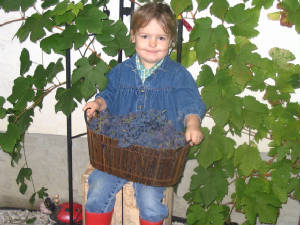
 -Grapes (table and wine)- Often associated with warm, desert-like environments, there are numerous cultivars of grapes for fresh eating and wine making that can be grown in northern gardens. According to Dyrland, “Where you place grapes is crucial. They need sun and shelter from the wind.” Fall pruning and heavy mulching is also necessary to maintain the health of the plant. Your efforts will be well rewarded when fruit appears after its third season. Recommended varieties include: Valiant, Beta and Cliché.
emmawithgrapes.jpg
Harvest off one four-year old vine at Shallow Creek Nurseries.

Another small aside: I had four varieties of grapes... now I have three because I, again, did not follow instructions and experimented with leaving the vine unpruned over the winter. Now in their third season on the south side of the house, I am expecting a bountiful harvest this year from the remaining vines. Watch for my report. 

- Red or Black Currant- “People shy away from currants because they seem like an old-fashioned fruit, but there are great fresh eating and preserving varieties,” says staff at Sunstar Nurseries. Currants, if left alone, will grow into a 3 x 3 foot bush however they can be trained into a fruiting column or globe form. For a beautiful screen, espalier them against a wall or trellis. This is a showy and versatile fruit.  Dyrland recommends any variety that starts with “Ben” like the Ben Conan, Ben Nevis, and Ben Sarek. Check our The Fruit Nut's Blog for extensive information on currants and instructions to espalier one.

Next Fruitscaping post: Trees. 

This reprint is part of an article I wrote for Gardening for the Prairies, Winter 2012. Over the next few days, in time for planting season, I'll publish the list of fruit options you might consider when making landscaping decisions. Planting prairie fruit doesn't have to be limited to the veggie patch or a brambling patch of raspberries in the alley. In this series, we'll look at fruit you can use for ground cover, vertical cover, screens, feature plantings... When it comes to fruit-scaping, thanks to the U of S's many new fruit varieties, us northern gardeners are limited by our imagination, not our Northern climate!


Monday, April 30, 2012

Fruitscaping: Introduction


The following is a reprint of an article I wrote for Gardening for the Prairies, Winter 2012. Over the next few days in time for planting season, I'll publish the list of fruit options you might consider when making landscaping decisions. Planting prairie fruit doesn't have to be limited to the veggie patch or a brambling batch of raspberries in the alley. In this series, we'll look at fruit you can use for ground cover, vertical cover, screens, feature plantings... When it comes to fruit-scaping, thanks to the U of S's many new fruit varieties, us northern gardeners are limited by our imagination, not our Northern climate!

Accompanied by my daughters, summer mornings begin with a stroll around our small urban lot. We scan for new flowers and interesting bugs as I grip my coffee. They grip their buckets and into these we drop our breakfast: berry treasures ripe to bursting.

Eager for more of these delicious harvests, I’ve begun to landscape my yard differently. Instead of grass, I’ve planted strawberries. In between hostas, I’ve planted honeyberries. Next to Virginia Creeper, I’ve trellised grapes. In every prairie yard, there is the potential for a fruit paradise. Thanks in large part to work at the University of Saskatchewan, every year larger and sweeter prairie-hardy fruit varieties are developed.


“There is major growth in demand for edible landscaping,” says The Urban Farmer, Ron Berezan. “Many people are beginning to want a beautiful and functional yard- a garden sanctuary where food grows too.”

Landscaping with fruit offers exciting possibilities for gardeners wanting to experiment with edibles outside the traditional garden box. “There is an incredible selection of hardy fruit for the prairies, people just don’t know about them,” says Shannon Dyrland, owner and operator of Shallow Creek Nurseries. “Prairie fruit flavours are intense and robust. Despite what many think, new varieties are exceptional for eating fresh from the bush.”  (INTERESTING FACT: Prairie fruit will almost always be smaller than the commercial varieties. They will also always have a seed or a pit.)

Check in tomorrow for the first in a short list of the more interesting and delightful hardy fruit you might consider planting this season.  

Sunday, June 26, 2011

The Alpine Strawberries Take Off: A View of an Old Lasagna Garden

About three years ago, this section on the south side of our house, north side of the fence, was grass. We stripped the grass because it was mostly weeds and lasagna gardened it with newspaper, compost and grass clippings. Unfortunately, we didn't have a 'planting' plan beyond that. It's been a slow process of trying to decide what I wanted in the section, this year, it's finally filling in. 
These day lilies were transplants from a friend that I planted last August. I suspect they will give the strawberries a run for their money. In the foreground, are the alpine strawberries that I planted from seed last year. This carpet of strawberries started with about four seedlings last July! (See more on alpine strawberries in this post.)

The strawberries take over the paving stones and concrete sidewalk!

Some mint that I planted from seed in a pot last year... well it kinda got away! It is now quite nicely filling a metre long section of the garden. The great thing about 'wild' mint is that it is an easy, lovely smelling plant to pull out- useful too, though I must admit that my mojito and mint tea consumption is not keeping up!

There's a 10 foot section of black raspberries, red raspberries and interspersed rhubarb at the end of this section. These two varieties of raspberries are not supposed to be planted together since a disease that the red raspberry carries, but is not harmed by, can do major damage to the black raspberries. Unfortunately, I am running out of space, and don't have anything in the yard that would be that much farther from the other red raspberry patches in the yard... So I take a risk. So far, they've been safe. These black raspberries have canes more like a blackberry in that they are looooong! But they don't sucker and so are quite a contained plant when I tie the canes to the wires fashioned by Mat. The black raspberry variety has a really different flavour and is nice compliment to a mouthful of red.

The red raspberries have been somewhat contained by, what I can only imagine, is a hatred for  potatoes. A few years ago I planted potatoes in this section, just to see how they grew in part shade. Every since, the raspberries have not seemed interested in sprouting in the past potato muck. It was only later that I read in "Carrots Love Tomatoes" that these two plants are NOT companion plants... I know nothing more about it. If you do, please comment!

The beginnings of a high bush cranberry hedge. In five years, I may be annoyed that I planted a hedge (along where the day lilies are planted now) in this narrow section of the garden. It may give our pruning shears a run for their money. But, right now, I want the fruit, the view of the beautiful colour and shape of these leaves from my dining room, and a little privacy from our south side neighbour's deck into our kitchen. I really love these leaves... and how great they look against the delicate strawberry runners.

Sunday, May 15, 2011

My Honeyberry Blooms

Berryblue 

Hurray- this week my honeyberries bloomed!  Two summers ago I planted six honeyberries. Since you need at least two varieties to cross pollinate, I was extra careful and bought three varieties. Last summer, I harvested a record of seven berries off one bush. This summer, my goal is to harvest... well, more. There are many more blooms on all the bushes this time around. 

I've experimented a little with the placement of each. Reading that they grow in both part shade and sun, I've planted the six in a variety of sunny to shady spots. There hasn't been much variation in the amount of growth on each bush, perhaps I'll see the difference in the fruit output.

The fruit, if you've never seen it, is a blue, elongated berry shape. The plants come from Siberia and their blossoms withstand -8 to -10 C frosts. The woman I bought my plants from had bushes which bloomed straight through a snow storm and went on to produce a rich harvest. 

The flavour of my seven berries was pretty mild; each was seedless and plump. According to the researchers at the U of S Fruit Program, however, flavour can range from "terrible to terrific" so there is still ongoing experimentation in the flavour department. 

Shannon Dyrland, who's Shallow Creek Nurseries closed last year, recommends the varieties Cinderella, Berryblue and Bluebell. Many of the greenhouses now carry at least a couple varieties of honeyberry.

Keep in mind too, if you plan to landscape with these, that they aren't fussy about soil Ph, which can't be said for their cousins the blueberry and huckleberry (both need acidic soil). 

So, if you have a honeyberry bush, please let me know where you've planted it and if the fruit output has changed significantly when planted in the sun versus the shade! 

I'll keep you posted on my ambitious goal of "Eat More Than Eight Honeyberries in 2011".

Saturday, May 7, 2011

Sustainability of Small Farms: Q & A with John Schneider


My main intent in these interviews is to understand the business of family farming-- and to understand how Alberta's farms can be sustainable, both financially and environmentally, for the sake of the province's food security.  


INTERVIEW WITH JOHN SCHNEIDER of GOLD FOREST GRAINS

Gold Forest Grains is a certified organic grain farm located just 30 minutes north of Edmonton. You can buy Gold Forest Grain's flour, pancake mix, flax seed and other products at Strathcona Farmer's Market, City Market and Alberta Avenue Farmer's Market. To buy bulk, contact John through his blog


1) How long have you been farming? 

 My son Garreth, or daughter Gretta will be the 5th generation of Canadian Farmers in our family should they choose to continue farming. I suspect that will depend on whether or not I am successful at making our current farm profitable. I have been farming since I was old enough to sit between my Dad's legs on the old Allis Chalmers tractor to be able to steer while we were plowing. I was about 10 I guess. I have had periods of my life where I was away from the farm working in the high rise towers of Edmonton. GFG has been operating for 7 years. Before that, it was my Dad's farm where we grew grain on about 2000 acres. Dad sold the farm during my stint away from farming and during a time when I didn't think I would return to farming. 

2) Next to Farmer, do you have another profession(s)?

I am a safety consultant in the construction industry. Currently, I am trying to stay afloat financially by consulting for small companies of all different kinds to get their safety programs up and running. Before Christmas I was laid off from a permanent part-time position at a local construction company as they struggle to get busier. Perhaps I will return to that company as they get busy this summer. Perhaps I will continue to consult to other cos.

3) You have written about taking odd jobs to keep financially viable,  this is something I know has been happening for years- farmers mining, farmers trucking. What are the benefits and problems with needing off-farm income? Is it a blessing or a curse?

To me, working off-farm is a definite curse. It takes away from my attention to the farm. Especially at this stage where we have just relocated the entire farm operation. I have built our house and an out-building but there is still so much to do along with the business of getting seed in the ground and maintaining the equipment etc. etc. I wish desperately, to be able to make my living strictly from the proceeds of my farm.

4)  The 'family farm'  is often talked about with notes of nostalgia-- What, by your definition, is the family farm?

My definition of a family farm is I suppose the same as everybody else's. Your question has me thinking about different ways to define the term "family farm". I know several family farms that are operated with foreign workers and live-in farm hands while the owner does whatever else interests him. I guess I define "family farm" as a relatively small farm operation where the members of the immediate family perform the farming activities. 

5)  What are the implications to Albertans and to the Alberta economy if the family farm was to disappear??

That is such a great question Carissa. I am not entirely sure what the implications are to the economy if we lost family farming. The large corporate farms are oftentimes foreign owned. They are usually subsidized heavily. We all know the story of corporate taxation on our continent. The rich get richer. If there were nothing left but corporate farms, my wages would be lower for performing farm activities...I would be making minimum wage I suspect (although there is an arguement that I don't even make that now! LOL) Even more foreign workers would come in to Alberta willing to work hard for less money. There are many scenarios that I am not smart enough to foresee. It would be a tragedy though to lose the way of life that has been a fabric of our society for so many thousands of years. I doubt that will ever happen. I am optimistic that the family farm will return as more and more people such as yourself make the conscious decision to purchase direct from the farmer instead of the supermarket.

6) One reason I feel concerned about the loss of numbers of farms, shrinking diversity of farms, and increasing scale, is that I wonder if we (Albertans) put our food security at risk. Is this concern valid? Thoughts?

Well, all I know about this is that I know of no incidents of people getting sick or dying from eating properly produced local farm products be it high risk products like milk or otherwise. The same cannot be said for corporations like Maple Leaf Foods now can it? 

What about the extreme short sightedness of corporate farming to blindly blunder into the world of GMO? Ever increasing usage of chemical inputs? Food security is really one of the least of my concerns compared to the world scale threat to our ecology and health. 

Why is there such an increase in milk sensitivity? Gluten intolerance? Peanut allergies? The simple fact is that human beings cannot de-evolve that quickly. We have been eating grains for at least 10's of thousands of years. We have not suddenly become allergic to wheat...that is ludicrous in my opinion. Is gluten sensitivity a mis-diagnosis of chemical sensitivity? A recent study in the UK found common farming-practice pesticide residues in bread on the grocery shelves...except for the Organic Samples! Even eating so called Whole Wheat flour from the store is not really "entire wheat". Much of the roughage that we need for proper health has been removed. Another article could be drafted discussing the human health benefits of eating "entire grain" products. The bad press of high-glycemic bread would not exist if the studies were done using bread that contained the entire grain in its flour. 

7) What do farms like yours need in order to be financially sustainable (or what are the systemic factors that challenge your financial success?)?

We are on our way to becoming financially sustainable. We are taking our produce and making it into a processed product that the consumer can use in their homes. We are doing this processing right here on the farm. By growing grains and turning them into freshly-milled flour we take the profits that would have been lost by trucking, milling, trucking again and finally retailing. The only problem with all of this is that the grocery stores have the advantage of everybody knowing they are there! I happily continue to struggle to get people to know we are out there. From our living room at night, I can see the lights of Edmonton sparkling and I think about all those people that use flour and would like to purchase directly from the farmer.

I think though that the key to all family farms becoming sustainable is both an infrastructure for consumers to buy the food and an education that meat, milk and produce from local farms is the responsible choice. An education that food shouldn't be cheap. It should be fairly priced, from environmentally sustainable practices and fresh. I would love to see a large chain of grocery stores that carry nothing but produce from local farms. Perhaps farmers markets will evolve into this model, but I still see so many challenges there. Consumers need to have the choice to buy bacon from one farm or another instead of just whatever farmer is represented at that particular market. Producers also need to get active with marketing and packaging to make their products professional in appearance. 

8) Besides purchasing food at farmer's market or CSAs (direct from the farmer), what can consumers do to advocate for more sustainable financing for small scale agriculture in Alberta?

There is nothing more that consumers need to do other than consume our products. That act alone will make small-scale, family farms viable. Once they are viable, they won't need financing. Once they don't need financing, the banks will be tripping over themselves to finance us! 

9) How do you determine pricing for your flour (the main considerations)? 

 For us, pricing is based on comparing current grocery store prices. We check prices on a regular basis to make sure that we are right around the current, acceptable pricing for organic flour. We do not charge a premium for being local...that's just silly to us. If anything, we would like to be in a position to be able to lower our prices. For now though, we are using established pricing from successful companies who have done all the figuring for us! Currently, with the cost of production of the grain and the cost to mill, package and transport to market, and the cost of the market itself...it is not a very big profit margin. We continue to lose money on our farm which is why I have to get a job elsewhere. I haven't been marketing grain direct to the consumer long enough to be able to do a cost analysis so I will have to get back to you on that. For us, we have many determinations for pricing to consider...land costs, fuel, taxes, labour, equipment repairs, equipment purchases, packaging, electricity, etc. etc. Once we can produce flour on a full-time basis including the actual production of the grain, we will be in a position to really crunch the numbers. If we can sell a whole bunch more flour, we will start to make a profit...that's all I am focused on right now. 

10) What could government or consumers do to help you be competitive?

Buy more flour products from our farm! 


Sunday, May 1, 2011

First Plantings for the Square Foot Gardens

Last weekend (April 22) I covered the oldest of the gardens (planted 2008) with 1.5 inches of sheep and cattle manure. By the end of last season it was clear the soil needed nutrients: at the end of their third year they were producing carrots and beets half the size of the new gardens. This year I plan to experiment with a couple types of home-brewed, liquid fertilizers: stay tuned. 
No chance I'll be planting this garden in the next couple weeks!

Lovage, mustard and flax line the back of this garden. I use these square foot gardens like a greenhouse or cold frame- I plant the cold-tolerant seeds early and will move most seedlings to other spots in the garden. 

If you can see my scrawling on the sticks, I've planted 3 square feet of hyssop with 16 seeds each for a total possible 48 plants... I want to do a mass group planting in the front boulevard of our house and I guess I really love hyssop! There are four squares of swiss chard planted in the centre of this bed: Swiss Chard regenerates after cutting, so I won't worry about succession plantings (for those who don't know what that is, it's doing a number of plantings spaced a week or two apart to stretch out the harvest). Four is probably too much swiss chard- but if it goes crazy in the middle of summer, I'll pull the two north squares and plant spinach there (which will benefit from the shade of the fully grown swiss chard up front!).

Here's a map of the two boxes as I've planted them now. I include the date I plant it and often the variety. About half of these boxes will become empty at the end of May as I use the seedlings to plant my yard's gardens (hyssop, cornflower, sunflowers, lovage, mustard and flax will be moved) and my deck pots (nasturtiums, lettuce, red teff grass will be transplanted). 

A closer look. 


It's terribly ugly, I know, but I'm experimenting with creating a micro climate that will extend my season, without the need to build further cold frames and greenhouses. What the tent lacks in attraction, it makes up for in utility-- after a week about half of the seedlings have germinated with the arugula about two weeks from being harvestable. As for the garden on the right side, I've covered it with frost- cloth sold for tomatoes. It also has been effective in keeping the soil warm enough for many of the seeds in this box to germinate. The trick now is keeping the seedlings alive despite the dipping night temperatures. Last year I covered many of the seedlings with the bottoms of pop bottles- which created mini-greenhouses (technically these are often called 'cloches' but pop bottles/ milk jugs are cheaper!). This year I'm trying out old windows. Placed over the top of the boxes, these windows have worked similarly to the cloches. I will need to watch, however, that the seedlings underneath don't burn as our daytime temperatures inch up.

Oh, how nice it is to finally be outside- working and sweaty!

As an aside: happy voting, Canada!

Thursday, March 24, 2011

Seed Starting 2011- In pictures

Nothing like a four year old in charge of dirt... The aprons were a gift at Christmas, bought by my sister in law from an Etsy shop.

Unfortunately, parts of my fancy 'self-watering' Lee Valley seed starters were food for the winter mice in the garage. I salvaged the tops and placed the capillary mat (that draws water up) in a glass 9x13 pan from the kitchen. This seems to be working. 

Madi is learning to write- and made most of the labels that were taped to the sides of the flats, directly under the designated cells.

Remember when I said I was 'going simple'? I couldn't help myself and ordered, then planted 8 cells, of Goji berries.

I'd love to hear how you organize. I place all my seeds in different bags: "Indoors 12 weeks" (plant before first frost free date. Here in Edmonton that's anywhere between May 7and 31!) "Indoors 8 weeks", "Indoors 4 weeks" and "Outdoors early"and "Outdoors late"

I keep this stuff close: scissors, pens and tape for labels. The green  bulbous spike is for seeding- $4 allows me to drop one seed in each hole at a time (instead of scattering heaps of seeds to later be 'thinned').

My garden book has coils so I can tape extra seed packs in, I also staple in most of my seed and plant orders so I can remember varieties and quantities from year to year.
The calendar allows me to count forward and back from May 7th. I'm an optimist when it comes to frost. I like Lois Hole's advice in her Vegetables book-- 8 out of 10 times you win when you plant a little early- harvesting at least 2 weeks earlier. The risk is that your first sowing of seedlings like carrots and peas die in a late frost but only, according to her math and experience, 2 out of 10 seasons. 

My scratchings.
 Date on top then a rough chart: Row 1: Name of seed. Row 2: Number of cells planted. Row 3: Date planted. Row 4: Date of germination (the first sign of green)


Tell me how you keep track and stay organized! I'd love to know.