Showing posts with label edible landscape. Show all posts

Friday, May 11, 2012

Fruitscaping Ideas: Trees and Possibilities for Hedgess


TREES
 -Dwarf Apple- There is a growing number of options in dwarf apple trees. These trees generally grow to a maximum height of 8 to 10 feet high- perfect for the small yard. The great thing about apple trees, besides the fruit, is that they respond well to pruning. A small tree can become even smaller! Apple trees can even be trained to grow in 2-3 foot tall hedges- a perfect border for an herb garden. As varieties go, I've been very happy with my September Ruby variety: exceptional for fresh eating and baking.

 -Pears- Reliable varieties of pears grow in the prairies, though the jury is still out on whether any are good for fresh eating (my sister-in-law has a very good unknown variety in her Edmonton backyard). Pear trees are often too large for an average-sized yard (especially as two are required for pollination) however they are amazingly versatile. They graft well onto apple trees and can be espalied to beautiful effect along walls and arbours.

-Beech Hazelnut- Hazelnuts are delicious fresh or dried. Grown in the form of a multi-stemmed tree or bush, it tops out at 15 to 18 feet. The Urban Farmer suggests trying the new crosses from the University of Saskatchewan. Crossing European with native cultivars, the new variety is called “Filazel”.

AS HEDGE OR FAST SCREEN

-Saskatoons- In the wild these fruit are often small and seedy but cultivated varieties can be as large as a blueberry, super sweet plus they pack a nutritional punch. Per 100 grams, they easily beat blueberries in their protein, fibre, iron, potassium and vitamin C levels.   Saskatoons also make a great hedge. Dyrland recommends trying Nelson, Honeywood, Thiessen.

- Sour Cherries- Don’t let the name scare you, new varieties like Juliet, Cupid and Crimson Passion are easily eaten fresh from the bush. Cherries can be trained into a hedge, a tall bush or a single trunk tree. Water well and harvest when the fruit easily falls. For the best preserves, Dyrland recommends Carmine Jewel. For proven fruit production and size, Sunstar Nurseries recommends planting an Evans.


If you can recommend any varieties, please do so in the comments section!


This reprint is part of an article I wrote for Gardening for the Prairies, Winter 2012. Over the next few days, in time for planting season, I'll publish the list of fruit options you might consider when making landscaping decisions. Planting prairie fruit doesn't have to be limited to the veggie patch or a brambling patch of raspberries in the alley. In this series, we'll look at fruit you can use for ground cover, vertical cover, screens, feature plantings... When it comes to fruit-scaping, thanks to the U of S's many new fruit varieties, us northern gardeners are limited by our imagination, not our Northern climate!


Tuesday, May 1, 2012

Fruitscaping- Vertical Space: Walls or Trellises


So you want to plant some climbing fruit on your wall or trellis? Perhaps you have a pergola that could use some coverage? As you begin experimenting, consider planting the following fruits in combination with hops or virginia creeper (for fast, dense coverage) or scarlet runner beans or clematis (to add some colour).

-Kiwi- Grown in Canada for many years, the fruits are smaller than commercial varieties and the skin is smooth. Fresh, it’s eaten more like a grape: skin and all. While technically a Zone 4, there are many warm ‘pockets’ where kiwis will thrive. Find a south- facing wall, make sure it’s protected (by fence or hedge) from prevailing winds and provide the vine with a strong trellis. Sunstar Nurseries carries, and recommends, the Issai variety as it is self-pollinating. 
<b>ISSAI</b> Hardy Kiwi
Issai Kiwi


As a small aside: I have killed my Kiwi. But I would like to think this is because I didn't follow the instructions to plant it on the south side of my house. I ended up moving the poor thing three times in three seasons and eventually it just gave me the heave-ho-gonna-die-on-you-lo. Will be planting another one this season, in the proper Zone 4 space.

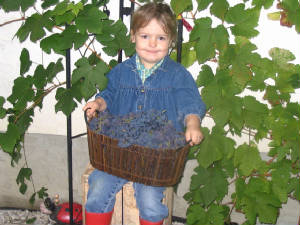
 -Grapes (table and wine)- Often associated with warm, desert-like environments, there are numerous cultivars of grapes for fresh eating and wine making that can be grown in northern gardens. According to Dyrland, “Where you place grapes is crucial. They need sun and shelter from the wind.” Fall pruning and heavy mulching is also necessary to maintain the health of the plant. Your efforts will be well rewarded when fruit appears after its third season. Recommended varieties include: Valiant, Beta and Cliché.
emmawithgrapes.jpg
Harvest off one four-year old vine at Shallow Creek Nurseries.

Another small aside: I had four varieties of grapes... now I have three because I, again, did not follow instructions and experimented with leaving the vine unpruned over the winter. Now in their third season on the south side of the house, I am expecting a bountiful harvest this year from the remaining vines. Watch for my report. 

- Red or Black Currant- “People shy away from currants because they seem like an old-fashioned fruit, but there are great fresh eating and preserving varieties,” says staff at Sunstar Nurseries. Currants, if left alone, will grow into a 3 x 3 foot bush however they can be trained into a fruiting column or globe form. For a beautiful screen, espalier them against a wall or trellis. This is a showy and versatile fruit.  Dyrland recommends any variety that starts with “Ben” like the Ben Conan, Ben Nevis, and Ben Sarek. Check our The Fruit Nut's Blog for extensive information on currants and instructions to espalier one.

Next Fruitscaping post: Trees. 

This reprint is part of an article I wrote for Gardening for the Prairies, Winter 2012. Over the next few days, in time for planting season, I'll publish the list of fruit options you might consider when making landscaping decisions. Planting prairie fruit doesn't have to be limited to the veggie patch or a brambling patch of raspberries in the alley. In this series, we'll look at fruit you can use for ground cover, vertical cover, screens, feature plantings... When it comes to fruit-scaping, thanks to the U of S's many new fruit varieties, us northern gardeners are limited by our imagination, not our Northern climate!

Monday, April 30, 2012

Fruitscaping: Introduction


The following is a reprint of an article I wrote for Gardening for the Prairies, Winter 2012. Over the next few days in time for planting season, I'll publish the list of fruit options you might consider when making landscaping decisions. Planting prairie fruit doesn't have to be limited to the veggie patch or a brambling batch of raspberries in the alley. In this series, we'll look at fruit you can use for ground cover, vertical cover, screens, feature plantings... When it comes to fruit-scaping, thanks to the U of S's many new fruit varieties, us northern gardeners are limited by our imagination, not our Northern climate!

Accompanied by my daughters, summer mornings begin with a stroll around our small urban lot. We scan for new flowers and interesting bugs as I grip my coffee. They grip their buckets and into these we drop our breakfast: berry treasures ripe to bursting.

Eager for more of these delicious harvests, I’ve begun to landscape my yard differently. Instead of grass, I’ve planted strawberries. In between hostas, I’ve planted honeyberries. Next to Virginia Creeper, I’ve trellised grapes. In every prairie yard, there is the potential for a fruit paradise. Thanks in large part to work at the University of Saskatchewan, every year larger and sweeter prairie-hardy fruit varieties are developed.


“There is major growth in demand for edible landscaping,” says The Urban Farmer, Ron Berezan. “Many people are beginning to want a beautiful and functional yard- a garden sanctuary where food grows too.”

Landscaping with fruit offers exciting possibilities for gardeners wanting to experiment with edibles outside the traditional garden box. “There is an incredible selection of hardy fruit for the prairies, people just don’t know about them,” says Shannon Dyrland, owner and operator of Shallow Creek Nurseries. “Prairie fruit flavours are intense and robust. Despite what many think, new varieties are exceptional for eating fresh from the bush.”  (INTERESTING FACT: Prairie fruit will almost always be smaller than the commercial varieties. They will also always have a seed or a pit.)

Check in tomorrow for the first in a short list of the more interesting and delightful hardy fruit you might consider planting this season.  

Sunday, May 15, 2011

My Honeyberry Blooms

Berryblue 

Hurray- this week my honeyberries bloomed!  Two summers ago I planted six honeyberries. Since you need at least two varieties to cross pollinate, I was extra careful and bought three varieties. Last summer, I harvested a record of seven berries off one bush. This summer, my goal is to harvest... well, more. There are many more blooms on all the bushes this time around. 

I've experimented a little with the placement of each. Reading that they grow in both part shade and sun, I've planted the six in a variety of sunny to shady spots. There hasn't been much variation in the amount of growth on each bush, perhaps I'll see the difference in the fruit output.

The fruit, if you've never seen it, is a blue, elongated berry shape. The plants come from Siberia and their blossoms withstand -8 to -10 C frosts. The woman I bought my plants from had bushes which bloomed straight through a snow storm and went on to produce a rich harvest. 

The flavour of my seven berries was pretty mild; each was seedless and plump. According to the researchers at the U of S Fruit Program, however, flavour can range from "terrible to terrific" so there is still ongoing experimentation in the flavour department. 

Shannon Dyrland, who's Shallow Creek Nurseries closed last year, recommends the varieties Cinderella, Berryblue and Bluebell. Many of the greenhouses now carry at least a couple varieties of honeyberry.

Keep in mind too, if you plan to landscape with these, that they aren't fussy about soil Ph, which can't be said for their cousins the blueberry and huckleberry (both need acidic soil). 

So, if you have a honeyberry bush, please let me know where you've planted it and if the fruit output has changed significantly when planted in the sun versus the shade! 

I'll keep you posted on my ambitious goal of "Eat More Than Eight Honeyberries in 2011".

Sunday, February 27, 2011

Seedy Saturday- Chives

Chives grow throughout my flower gardens, however there is one bunching burst of green that makes me particularly happy.  It grows from a dark pot on the deck and its bobbing, nodding purple flowers offer splats of colour June through August. Like a pair of Camper Shoes, they're pretty and practical in equal measure. Three steps is all it takes me from the kitchen door to the pot. Six steps and I'm back to the stove with a burst of flavour for supper.

The flowers look like a large clover flower, though its colour and fragrance are more poignant. They remind me of the flower Horton found the Who's on; that regularly makes me smile. Close up I can't help wondering aloud to Madi, "Just what else lives on that speck there? And who's to say we aren't floating precariously on a speck of our own?"

Besides stirring some curious existential questions, I find the flowers a nice, mild treat to eat. Like a french marigold you can pop the flower right into your mouth. The texture is a little weird (never mind what all those Who's will do to your bowels), but their flavour is unique from the green bits.

Speaking of the green bits- they can be snipped off at any occasion and added to any dish (no lie!). Not only tasty, as a design element the greenery is a fantastic contrast to many flowers and herbs. People always use those Dracaena-type grasses, however I think that a couple pots with chives as the spiky centre is way more unique and practical. If its harvested around the outside edges in a plant feature, it maintains a nice tall, narrow shape.

My chives come from a couple sources. The first chives I planted were from my friend's mom, since once established they are easily shared. The second group grew from seed sown directly in the garden. They grow back faithfully ever year and each spring I split them and pop the transplants throughout the yard. For me, they flower happily in both part- shade and sunny spots.

With the potted chives, I am pretty lazy at the end of the year. I simply move the pots into the unheated, detached garage where they overwinter. When the spring melt begins, I bring the pot out and watch delighted as my chives reawaken in time to garnish my steak off the BBQ.

To buy garlic chives (with white flowers), check out Salt Spring Seeds where I've bought at least half my seeds the last couple years. Of course, Richters has an incredible selection of chive seeds on pg. 15 of its catalogue. Find it here.

Tuesday, October 5, 2010

Growing Grapes in the Alberta

My first grape harvest. This is from a two year old vine- so bunches are still small.
Grapes are one of those fruits that visitors are often surprised to see growing in our climate. While many locals have heard of the long-suffering Valiant grape, there are at least eight varieties of grape that grow in Zones 2-3. I have four varieties, 2 white and 2 red, and this year I had my first (small) harvest from the Eona vine. Planted two summers ago, the grapes grow on the south side of my stuccoed house. Thanks to the wall radiating heat, its extra hot and sheltered.

 The grapes were each about a centimeter in diameter and packed with the flavour of Welches Grape Juice. Picked at the end of September, they had survived (and possible thrived?) through one hard frost. The skin was soft, the fruit juicy. Then there were the seeds: Two! Two 2 mm seeds in each grape! The taste and value made the seeds worth the work- but they definitely slowed my consumption speed. Perhaps this is nature's way of reminding us where life comes from? Perhaps this is creation's way of imposing discipline in these times of fast food and eating on the run?

"Every prairie fruit you find will have a seed or pit," Shannon says. My wee grapes had 2 seeds per fruit! 

The process of food-scaping my yard has been long and slow; most plants require at least three to four years before they produce a harvest of significance (damn it, once again I am forced to be patient!). Shannon at Shallow Creek Nurseries- sadly now closed- has been a wealth of information and source of many varieties of fruit. Here are some of her recommendations for growing grapes in regions with hot summers and hard winters:

1. Where you place grapes is crucial- they need a sheltered spot with full south exposure. Be particularly careful to choose a home out of the wind.
2. Fall pruning should always be done to protect the plant from winter kill. Prune each vine down to the fourth bud.
3. In preparation for winter, shovel lots of snow on the remaining plants.
4. Don't expect fruit until the third season. Let the plant focus on its root system for the first few years.
5. After the third year, if you want to encourage fruit production then keep the vines pruned at about four feet high. If you want leaves for a trellis, of course let it grow, but don't expect a lot of fruit.
6. If the grapes are tart, you've picked them too early. Water them and wait another week or two. The fruit should get plumper and sweeter in this time.

While Shallow Creek Nurseries are no longer open, their website is a wealth of information on local fruit for the Prairies and can give you an idea of the possibilities for fruit in your yard. Read about the 8 different kinds of grape, 11 types of cherries, and 6 kinds of saskatoons. They also sold hybrid fruit varieties like Chums and Jostaberries, and unique cuttings from the Goji bush.

The greenhouses offer a disappointing number of varieties of berries. But I believe that the more people ask for them, the more likely that a market will grow- so ask ask ask!

Here are a few nurseries and garden centres that carry berries and fruit (there is still time to plant a clearance shrub or tree before winter!):

- Greenland Garden Centre
- Sunstar Nurseries
Address: (780) 472- 810 167 Ave. NE (Not as great a selection but they do have: apples, pears,  plums, honeyberry, saskatoons, currants, grapes, cherries)
- Arrowhead Nurseries- (780) 472-6260, Address: 2503 211 Ave NE (graft their own plums, apples, cuttings for honeyberries and cherries (romance series, sour cherries), grapes (valiant and beta), currants, josta berries, and pears))
- DNA Gardens (for black currants and hardy apples/plums/pears- Southeast of Red Deer.)
- Holes Greenhouse

Also, the online service at T& T Seed's is very good and their selection is better than most.

If you find other sources of great, hardy fruit, please let me know!

Wednesday, July 22, 2009

Slowly making the landscape edible

This year I planted many different edible plants purchased from Shallow Creek Nursery (http://albertafruittrees.tripod.com/). They specialize in hardy fruit for the prairies. I'm trying my luck at growing honeyberry (fabled to withstand frost to -10 C), black raspberries (they don't sucker like regular raspberries, so I planted them in my garden) and sour cherries (a Juliet). I was also seduced by the fanfare at health food stores and planted a Goji Berry.


Peppers, thyme, chives, mint, basil and sunflower sun on the deck.


Eona Grape- a green grape apparently good for eating fresh... we'll see. With mixed feelings I removed the Virginia creeper that was in this spot; It was a lovely plant, but infested with leaf hopper. In it's place I planted the Eona and a Stuben.


Coriander and Dill grow wildly together


Ever-blooming Strawberries are beginning to slow down production.


This Kiwi is a zone 4 that survived the winter! I have transplanted it to a sunnier spot and it is beginning to flower. I did harvest some small fruit last year. Very sour but apparently I can store them and they sweeten up. When established, this vine can grow up to 20 feet, though I'm curious to see how it will do with our shorter seasons. 


The black raspberries are on either end of the strawberry, kiwi and grape bed. The Kay Grey grape was a slow starter, but its beginning to catch up to its cousins planted in a different bed.


A Manitoba Tomato grown from seeds from Salt Spring Seed.


We planted this Dwarf September Ruby in 2006, the year our first daughter was born. We bought the tiny thing for $20 from a nursery that was transitioning into a U-pick. The apples are firm and refreshingly sweet-tart.


This large (12 foot!) unknown variety of Saskatoon has greatly increased its yields thanks to the Northline Saskatoon I planted this year. The berries have also substantially increased in size to about 15mm. 

In the hanging baskets I've tried Galina tomatoes and Spaghetti squash. The Squash is growing but certainly won't cover the pergola like it did in my dreams.